
The overnight hike


What the hike is
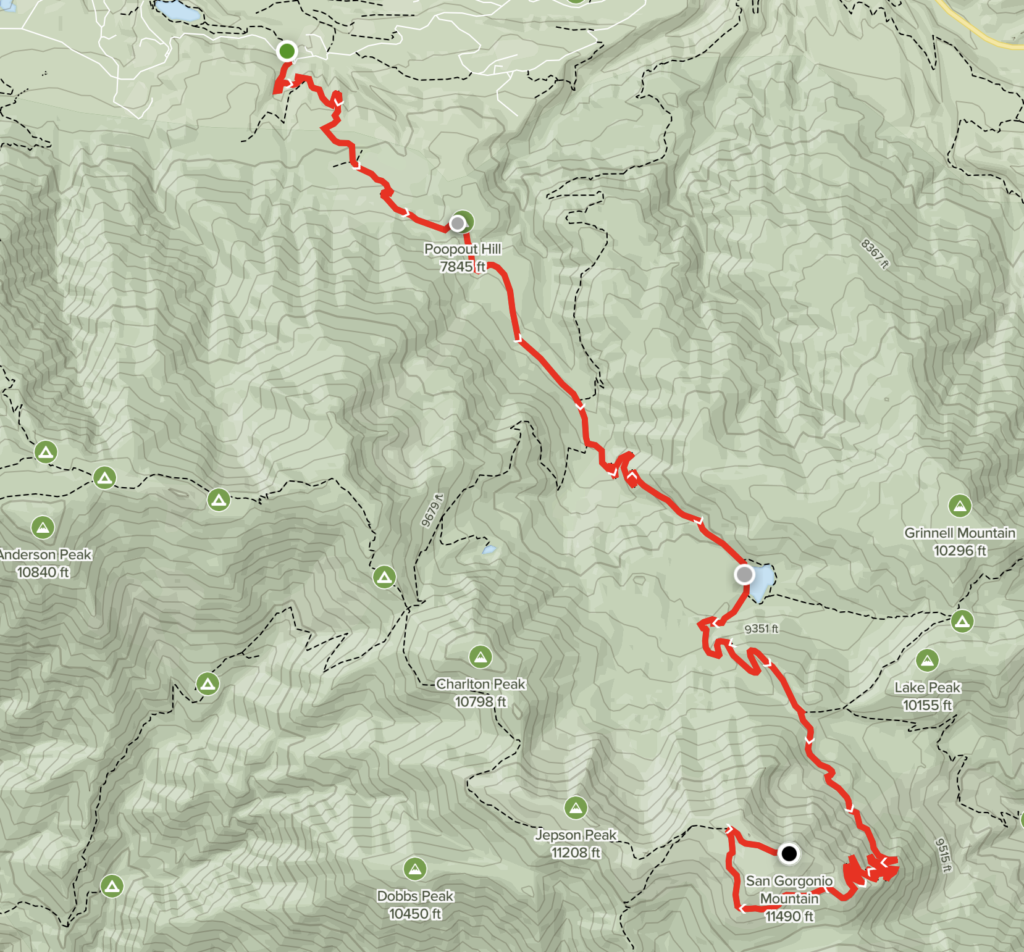
The Senior Summit Hike is an overnight backpacking trip to the summit of Mount San Gorgonio, the highest peak in Southern California at 11,503 feet. Over two days the group hikes about 24 miles round trip, climbing from a trailhead near 7,000 feet to the summit and back. The party hikes to a backcountry basecamp at Dry Lake (around 9,000 feet), sleeps there under the stars, and rises very early the next morning to reach the summit and then descend all the way down. Only our senior campers are permitted to take this hike (entering 9th or 10th grade).
It is a real challenge and a real accomplishment. Many campers have never backpacked or spent a night in the wilderness before, and for some this becomes one of the most memorable experiences of their lives. Our aim is to make it both safe and genuinely good.
Why we do it
The hike is woven into the life of Good Shepherd Bible Camp. Beyond the adventure, it is a setting for growth: perseverance when things are hard, teamwork and service toward one another, humility, and wonder at the beauty of God’s creation seen from high places. We open and close our days with devotion and prayer. The mountain has a way of teaching what a classroom cannot, and we consider it a privilege to walk it alongside your camper.

day 1: to basecamp
After an early breakfast at camp, the group drives to the trailhead and begins hiking mid-morning. The pace is slow and steady, with regular rest stops for water, snacks, and photos. Over roughly six miles and 2,200 feet of climbing, the group reaches Dry Lake, sets up a simple camp, gathers and purifies water, cooks dinner in small groups, and settles in for the night under the open sky
day 2: summit and out
The group wakes in the dark, breaks camp, and starts the summit climb before dawn — this early start is normal and important, so the group can reach the top and return with daylight to spare. After reaching the summit for a rest and lunch, the group descends back to basecamp, gathers the rest of their gear, and continues all the way down to the trailhead. It is a long, satisfying day.
Throughout, we hike in small groups and never race. We adjust our pace to the whole group — sometimes to the slowest hiker — and that is by design, not a problem. Everyone summits together, or as together as the mountain allows
how we do it
Safety and preparation are our highest priorities, and a great deal of thought goes into both.
- Small, led groups. Campers hike in squads of no more than twelve, each led by trained Group Leaders. Experienced guides oversee the whole hike, and the camp nurse supports the group’s health and first aid.
- Clear roles. Within each squad, campers take on specific helper roles — water, cooking, sleeping setup, and food storage — so everyone contributes and no one is overlooked.
- The buddy system, always. Campers stay with their group and move in pairs, including for restroom breaks.
- Communication and permits. Leaders carry radios and coordinate throughout, and we secure the wilderness permits the National Forest requires.
- Real preparation before we go. Prep week includes a registration session and afternoon training so every camper learns how to pack, hike, eat, hydrate, care for their feet, and handle the backcountry before setting foot on the trail.

food and water
You do not need to send any food. We provide the entire trail diet: each hiker carries roughly a full day’s worth of calories in bars, nut butter, jerky, dried fruit, and other trail food, and the camp kitchen provides a hearty breakfast on departure morning and a sack lunch for the first day. We also provide electrolyte drink mix for hydration. On the trail we are relentless about two things, and we ask you to reinforce them at home: you have to eat, and you have to drink. Hiking at altitude burns enormous energy, and campers often do not feel hungry even as their bodies need fuel. Our leaders check at every stop to make sure each camper is eating and drinking steadily. It is genuinely what carries a hiker to the top
WHat camp provides
So that you can pack light and simply, camp provides:
- All trail food, plus a camp breakfast and a sack lunch
- Backpacks fitted to each camper
- Sleeping ground cloths (we sleep under the stars — no tents)
- Camp stoves and cooking gear
- Water filters for backcountry water
- Bear-proof food storage
What your camper needs to bring
Footwear
- Sturdy, broken-in hiking shoes or boots
- Wool or synthetic hiking socks, plus spare pairs
Sun Protection
- Hat and sunglasses
- Sunscreen (the sun is intense at altitude)
Clothing (dress in layers)
- Moisture-wicking shirts (avoid all-cotton, which stays cold and wet)
- Comfortable hiking pants or shorts
- A warm layer such as a fleece or insulated jacket
- An insulated winter hat like a beanie – this makes sleeping overnight much more comfortable
- A rain or wind jacket
Sleeping
- A sleeping bag suitable for a possibly chilly night at 9,000 feet; most of the time the lows are in the 50s, but it can be colder
Personal Items
- Personal water bottles or a hydration reservoir – these should be plastic; metal and insulation add unnecessary weight
- A headlamp or flashlight
- Personal toiletries, lip balm, and any blister care
- Any personal medications, labeled
More on water
Water is one of the two things we are the strictest about on the mountain, so it is worth getting your camper’s water setup right before camp. Two mistakes are common every year and both are easy to avoid.
Please skip heavy, insulated bottles
Campers often reach for a metal insulated bottle like a YETI or an Owala. Leave those at home. On a trip where every ounce is carried thousands of feet uphill, a heavy bottle adds real weight and real fatigue — and insulation serves no purpose here. We are not trying to keep water cold; we just need to carry enough of it.
Bring enough capacity – this is the bigger problem
A single one-liter bottle is nowhere near enough. Between water sources a camper needs to carry at least two liters at a time, and three liters is better. We do our best to supplement campers with disposable bottles, but those are flimsy and hard to reuse, so we would much rather each camper arrive with their own sturdy, reusable storage.
What works best
The ideal setup is two plastic one-liter Nalgene wide-mouth bottles – lightweight, tough, inexpensive, and easy to refill and clean. If your camper can bring capacity for three liters (for example, two Nalgenes plus a third bottle or a hydration reservoir), even better. Two liters is the minimum, three liters is ideal.
Health, medications, and dietary needs
At registration, each camper has provided information about any allergies, dietary needs, medications, or medical conditions. For some conditions we may ask for clearance from your physician or the camp nurse. This is never meant as a barrier — it simply lets us plan the right support and keep your camper safe in a remote setting.
This is a strenuous, high-altitude trip. If you have real concerns about whether it is the right fit for your camper this year, please talk with us early. We would much rather work through it together in advance than discover a difficulty on the mountain, and we can help you and your camper make a wise decision.
what can you do as a parent?
Prepare your camper physically
The single best predictor of a good experience is preparation. In the weeks before camp, encourage your camper to get outside and walk or hike, gradually increasing distance and, if possible, hills. Even regular walks make the mileage and elevation feel far more manageable.
Just as important: break in their footwear well before camp. New, unbroken-in shoes are the most common cause of blisters, and blisters are the most common thing that makes a hike miserable. Have your camper wear their hiking shoes on those practice walks so both feet and footwear are ready
A few attitudes make all the difference, and you can help set them at home:
- Commit, and stick with it. Please help your camper make a firm decision about participating. Late changes are hard on the whole group
- Follow the leaders. On the trail, following instructions the first time is usually about safety
- Stay with the group and use the buddy system
- Expect discomfort – and know it passes. Tired legs and an early alarm are part of the adventure, and campers can do hard things
- Speak up early. The bravest thing a hiker can do is tell a leader right away when something feels wrong – a hot spot, a worry, a wave of tiredness. Small things caught early stay small